
Expansive Clay Soil: The Hidden Force That Cracks Foundations
If you live in Texas or other clay-heavy regions, you’ve probably heard the warning: expansive clay soil can wreck a home foundation. One season it’s dry, the soil shrinks. Next season it rains, the soil swells. That constant soil movement doesn’t just happen underground—it pushes and pulls on the slab your home sits on, which can lead to foundation cracks, sticking doors, and uneven floors over time.
Engineers classify many of these problem clays as “expansive” when the soil has enough plasticity to significantly change volume with moisture. One common benchmark is a plasticity index (PI) of 15 or greater—a frequent reality in Central Texas neighborhoods.
So what’s the fix when the ground won’t behave?
The Solution Used in Many Homes: The Post-Tensioned Slab
One of the most common modern answers is the post-tensioned slab-on-ground foundation—often called a post-tensioned slab or PT slab.
This isn’t a new or experimental idea. PT slabs are widely used in single-family residential construction and other low-rise buildings because they perform well and are cost-efficient. The Post Tension Institute (PTI) standard that guides much of this design work specifically notes that shallow post-tensioned foundations are commonly used in residential and light commercial construction.
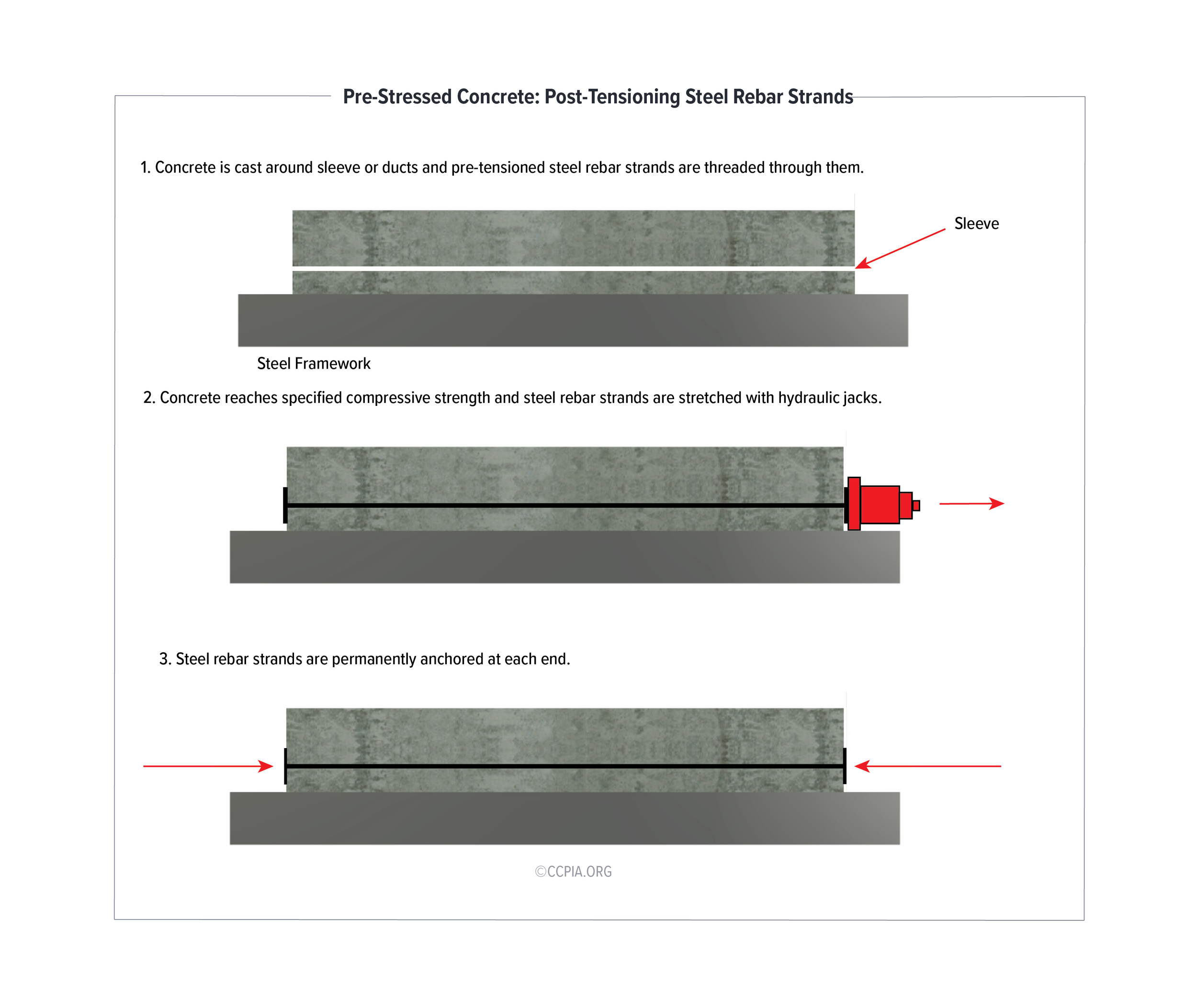
What is a post-tensioned slab (in plain English)?
Imagine pouring a concrete slab with steel cables (tendons) inside it. After the concrete hardens, those cables are tightened—like pulling a belt snug—and anchored at the edges. That tightening compresses the concrete.
Why does that matter? Concrete is strong when squeezed but weak when pulled. By keeping the slab under compression, a post-tensioned slab is far more resistant to cracking caused by shrinkage, temperature changes, and uneven support from shifting soil.
A common design target is creating an average compressive “squeeze” of roughly 50–150 psi across the slab—enough to help the slab fight cracking forces before they become visible problems.
The Story Clay Tells: Wet Edges vs. Dry Edges
Here’s where expansive clay gets sneaky: moisture doesn’t change evenly under a home.
Sometimes the edges get wetter (poor drainage, heavy watering, downspouts dumping near the house). That can make edges swell and lift.
Other times the edges dry out faster (heat, drought, thirsty landscaping). That can make edges drop while the center stays supported.
PTI design methods account for these real-world “modes” of movement—often described as edge lift and edge drop—so the slab is designed to stay strong even when soil support isn’t uniform.
Why Post-Tensioning Is So Widely Used
Homebuilders use post-tensioned slabs so much because they solve several big problems at once:
1) Better crack resistance
If the slab doesn’t have enough compressive force, cracks can form and open. Illingworth’s presentation makes it blunt: too little compression allows cracks. But adequate compression helps resist cracking and can even close shrinkage/temperature cracks.
2) Proven fit for expansive soils
PTI recognizes multiple foundation types depending on soil conditions—including stiffened/ribbed systems and uniform-thickness systems for expansive soils. In other words: it’s a standard, engineered approach for clay—not a guess.
3) Efficient construction
Post-tensioned slabs can deliver strong performance without needing extreme (and expensive) deep foundation systems in many typical residential situations. That combination—performance + efficiency—is why PT slabs are everywhere in new neighborhoods.
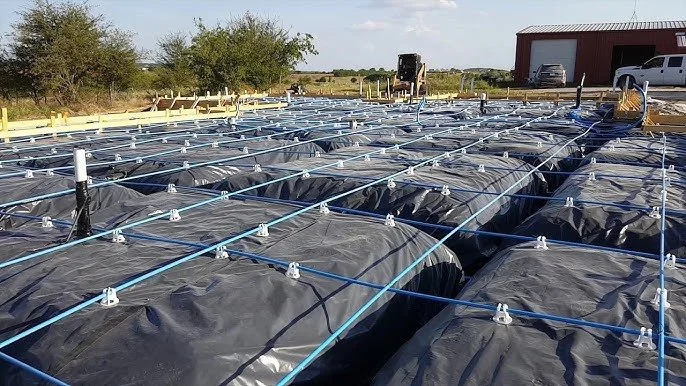
Ribbed post tension slab before pour
Ribbed vs. Uniform Slabs (Quick Homeowner Version)
You’ll usually see two common styles:
Ribbed (waffle) slabs: a thinner slab with deeper ribs (beams) underneath for stiffness.
Uniform-thickness slabs: a thicker “raft” slab without interior ribs.
PTI defines a ribbed foundation as a slab with ribs projecting downward in both directions, acting together as one system, while a uniform thickness foundation is a solid slab of consistent thickness.
Bottom Line: A Smarter Home Foundation for Moving Soil
Expansive clay soil is going to expand and shrink—no matter what. But a post-tensioned slab-on-ground foundation is designed to handle that story: the wet seasons, the dry seasons, the soil movement, and the stresses that crack ordinary slabs.
That’s why so many homes use it: it’s a proven, engineered solution that helps reduce foundation cracks, improves performance on expansive clay soil, and fits the realities of residential construction.
If you’re buying a home on clay soil—or noticing early signs of movement—understanding what a post-tensioned slab is (and how it works) helps you make smarter decisions about drainage, maintenance, and long-term foundation care.